 By
By As noted in part 1 of this series, my preferred method for removing organic matter from cast iron that I am restoring is a lye tank. While a lye tank only consists of two items: lye and water, some care needs to be taken during its construction in the interest of safety
Safety and Personal Protective Equipment (PPE)
The very property that makes lye useful for restoring cast iron (it dissolves organic matter) is actually harmful to us humans (as we are also organic matter).
It is important when working with lye that you wear proper PPE, such as gloves, an apron, eye protection, and face protection.
For reference, I use the following as my working PPE:
- Gloves – ThxToms Heavy Duty Latex Gloves You’d want gloves that are long enough so that if you need to dig to the bottom of the lye tank, no lye solution enters from the top of your gloves
- Apron – Aulett Home Waterproof Rubber Vinyl Apron You’d want an apron which is made of vinyl. In case of a spill, you want liquids to roll off of you
- Eye protection – Dewalt Safety Glasses Simple, but effective eyewear
- Respirator – 3M Half Facepiece Reusable Respirator Assembly 6391/07003(AAD), P100 A N95 or (preferred) N100 respirator
Acquiring an appropriate container for a lye tank
An appropriate container for a lye tank has the following three properties:
- Strength – The lye tank should be strong enough to support the full weight of water and pans it will hold. Water is very heavy at 8 pounds per gallon. A 20 gallon lye tank weighs roughly 160 pounds in water weight alone. When acquiring this vessel, ensure it is strong enough to support this weight. Rain barrels, & heavy duty buckets work well here. Light duty plastic bins such as those sold for clothing storage are not. The last thing you want is a spill of a lye solution in your workshop
- Size – The lye tank should have sufficient capacity to support the largest item you’ll be restoring. My original lye tank was a 5 gallon Home Depot Homer bucket, and it served me well until I needed to restore pans larger than 12 inches in diameter.
- Safety – The lye tank should be easily secured so that it is not a hazard to others. I personally like screw-top lids because opening a screw-top container is a very deliberate act, and cannot easily be done accidentally.
The lye tank that I currently use is an Eagle 1650 Yellow Blow-Molded HDPE Lab Pack with Screw Top Lid, 20 gallon Capacity, which can hold a ton of pans, and would be able to handle a 20″ cast iron pan, if I was to ever encounter one.
Acquiring Lye
It is important that you get 100% pure lye (Sodium Hydroxide) with no additives or colorants. As lye is used in many other commercial applications such as drain opener and pool conditioners, it may have added chemicals that you don’t want. Your lye tank will require 1 lb of lye for every 5 gallons of water. If you are purchasing lye from a brick & mortar hardware store, they may have it locked up. Unfortunately lye is also used in the production of some illicit substances, so many stores have locked it up and treat it like a low grade controlled substance.
As reference, I use Duda’s Red Hot Devil Sodium Hydroxide
Assembling your lye tank
Now that you have your tank and lye, it is time to assemble the lye tank.
Firstly, fill the tank with water.
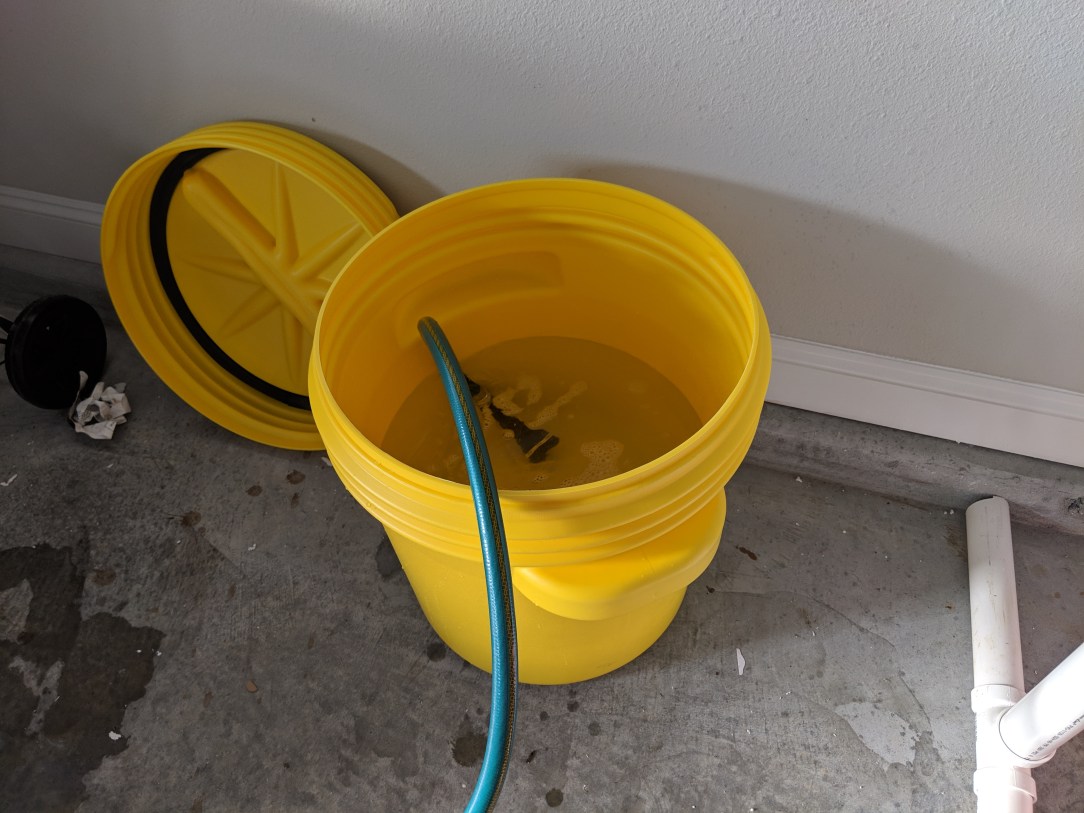
Next, add the lye to the tank. It is ABSOLUTELY CRITICAL that you add the lye to the water and NEVER add the water to the lye.
If you were to add the lye to the tank first and then add water to it, you would create an Exothermic Reaction which will splatter nasty lye and lye mist everywhere. Just because you are wearing PPE, it doesn’t mean that you wish to test its limits.
Order matters. The Vikings knew this. Loot. Pillage. THEN burn.
Water first. Lye second.
Now, stir up the mixture in the tank to get the lye crystals dissolved. Finally add some pans to the solution, close the lid, and allow the lye to work its magic. Periodically, pull your pans out of the solution so that they can be rinsed and scrubbed. Put them back into the solution as needed. Pans can stay submerged in the lye solution indefinitely.
Over time the lye solution will get increasing darker from all of the organic matter it has removed. But is still highly effective. See below:
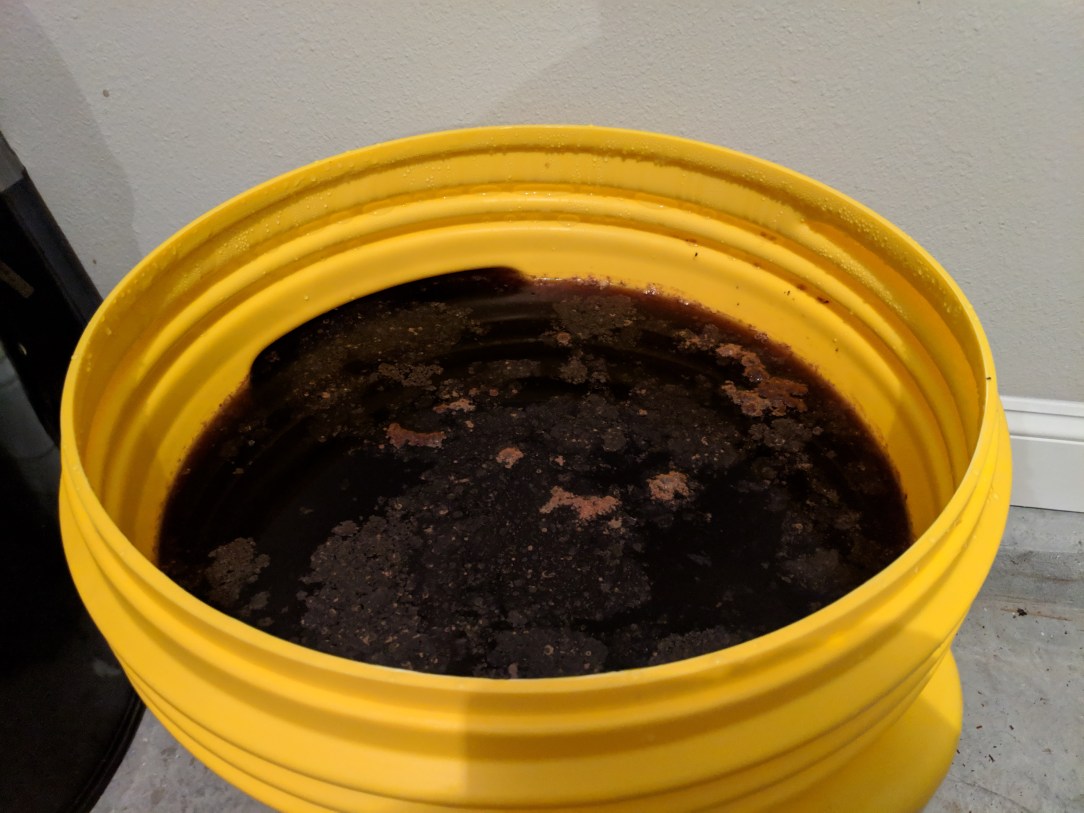
Other than periodically (like twice a year) straining the solution to remove large particles, it is good forever. If the water level gets low due to evaporation, simply add more water.
Disposal of Lye tanks
At some point you will need to dispose of the contents of your lye tank. This is actually much easier than it seems. A lye tank is nothing more than a gigantic bottle of drain cleaner. Dilute it with water, and flush it down your toilet if you are on city/sewage. Do NOT flush lye solutions if you have a septic tank. Alternate ways to dispose of lye including neutralizing the lye with an acid such as vinegar (returning it to a neutral-ish PH).
With the above knowledge, you can easily add a lye tank to your restoration repertoire.

 An Adventure in Cast Iron